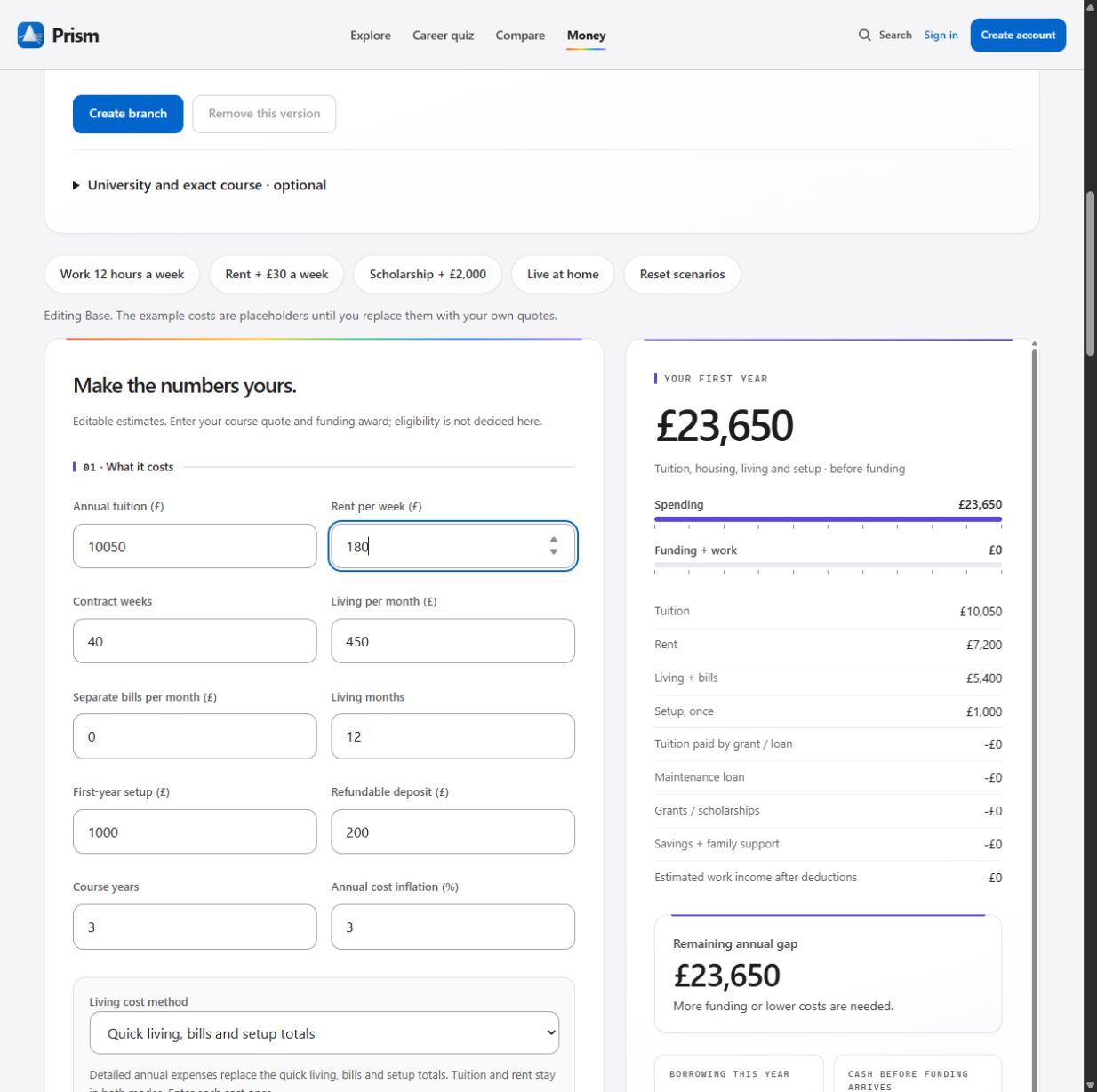
The budget keeps rent, contract length, living costs and funding visible as inputs. A visitor can change one assumption and inspect the new total before saving a plan.
01 / Walkthrough
● ● ● PRISM / SCREEN STUDY00:24
Change an example rent assumption and inspect the recalculated budget. Planning estimates only.Read the step-by-step notes ↗
A change you can check.
In the example budget, changing weekly rent from £180 to £150 across 40 weeks reduced the displayed annual cost from £23,650 to £22,450. This is an interface check using example figures, not a claim about a student's costs or savings.
Example rent of £180 per week across 40 weeks; the displayed annual cost is £23,650.
HOW THE PIECES CONNECT
Choosing a course also brings questions about a university, a possible career and everyday costs. Prism gives those questions their own routes, then brings research together in a personal plan. Visitors can begin exploring before creating an account.
The budget example makes one relationship easy to check: £30 per week across 40 weeks is £1,200. Changing that rent assumption updates the displayed annual cost by the same amount. Real quotes and funding awards are still needed for an actual plan.
03 / Build decisions
01 /
Let exploration come before an account.
Visitors can begin researching without signing in. Account-based planning provides a later place for a shortlist, research and budget, keeping open exploration connected to the decision to save a personal plan.
THE TRADE-OFF
People can inspect the experience first. Keeping a personal workspace introduces a sign-in step when they are ready to save.
WHAT TO CHECK
Open the public Money page without signing in. The example inputs and calculation explanation are available before account creation.
02 /
Make the assumptions editable.
Rent, contract length, living costs and funding remain visible as inputs. Changing one assumption updates the total, keeping the result connected to the values that produced it. The recorded example changes rent while leaving the other inputs alone.
THE TRADE-OFF
The estimate is only as useful as its assumptions. Control over the inputs does not replace real accommodation quotes or confirmed funding.
WHAT TO CHECK
£180 to £150 per week across 40 weeks changes the example annual cost from £23,650 to £22,450: a £1,200 difference.
03 /
Show what sits beneath the total.
The calculation disclosure exposes assumptions and exclusions, including upfront cash and the treatment of deposits. Visitors can inspect how the estimate is constructed before using it in their research.
THE TRADE-OFF
A detailed explanation takes space, so it sits behind a disclosure. Individual accommodation and funding terms still need checking with the provider.
WHAT TO CHECK
Open “Inspect the calculation”. The explanation distinguishes upfront cash from annual cost and explains how deposits are treated.
[ 01 / THE QUESTION ]
What could come next?
The problem
Choosing a course also means thinking about a place to live, a possible career and everyday costs. Those questions are connected, even when the research is scattered.
The approach
Prism gives each question a clear route, then brings the research together in a personal plan. Visitors can begin exploring without creating an account.
[ 02 / FROM INTENT TO INTERACTION ]
A path through the product.
01
Start with an interest
Follow a subject or use the interest questionnaire to find routes worth researching.
02
Compare the possibilities
Look at courses, universities, published student feedback and graduate outcomes.
03
Ground the decision
Explore career areas and adjust a first-year budget around living costs, funding and work.
04
Keep a plan
Collect a shortlist, research and budget in an account when ready.
[ 03 / UNDER THE SURFACE ]
Connected decisions.
01 /
Courses and places
The site separates what you study from where you study, while keeping both within reach of the same research journey.
02 /
Careers and costs
Career routes are starting points to investigate. The budget uses adjustable assumptions, so a visitor can see how a different choice changes the picture.
03 /
A personal workspace
The live experience includes account-based planning, a shortlist and recovery-code guidance. Beginning the research does not depend on signing in.
The name begins with shared light separating into different directions. The prism represents different lives and careers, with each route remaining open to exploration.
Education discovery and planning. Course details, costs and routes should be checked with the relevant university or provider before making a decision.